

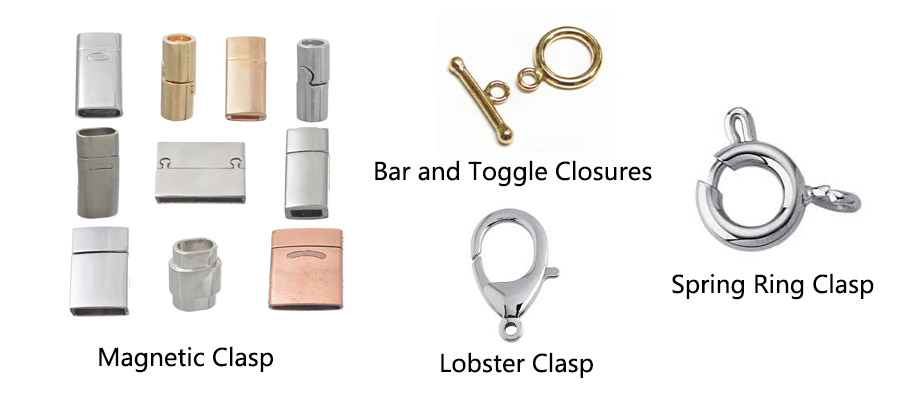
If you take a good look at your collection of jewelry necklaces or jewelry bracelets, you'll notice that there are many styles of jewelry clasps. Each type of jewelry clasp has its advantages and disadvantages.
Lobster Clasp
Also known as "trigger" clasps, lobster clasps are some of the most common options for closing necklaces and chains. These closures are typically ovals, but they can be other shapes as well. To operate the clasp, you pull back a tiny metal trigger. The trigger opens the clasp, allowing you to attach the other end of the chain or necklace. You'll find these on fine jewelry as well as on handmade items. Lobster clasps come in different sizes and materials to accommodate various weights and types of jewelry.
Lobster clasps are very strong since the ovoid shape means that the strain is never on the delicate part that opens. The only disadvantage to this style of closure is that it can be difficult to operate with one hand.
Spring Ring Clasp
Similar to a lobster clasps, a spring ring closure uses a tiny trigger. However, these clasps are always circular. They consist of a hollow open circle with an inner piece that retracts when you pull the trigger. This provides an opening for the other end of the necklace or chain. They come in a wide variety of metals and sizes, and some are embellished with engraving, two-tone decorations, and even tiny gems. You'll find these clasps on everything from fine jewelry to costume pieces, although they are usually used on items that are more delicate.
Because of the circular design and the relatively weak area where the inner portion of the clasp retracts into the hollow circle, spring ring clasps are not as secure as some other options. The inner part has a tendency to break or bend if too much strain is put on the jewelry, making them a poor choice for heavy necklaces or for bracelets that might catch on things.
Bar and Toggle Closure
Bar and toggle closures are great for bracelets since you can operate them with one hand. They feature a large ring on one end and a bar on the other. To operate the clasp, you turn the bar sideways and slide it through the ring. Since the bar is slightly longer than the ring's diameter, the clasp says closed. You'll find these in simple and ornate styles and from base metal as well as sterling silver.
Besides one-handed operation, the advantage of a bar and toggle closure is its beauty. This is a large clasp that adds a statement to a piece of jewelry. It can even be the focal point of some designs. However, this isn't ideal for every item. The bar can catch on hair when used in necklaces, making it less secure and potentially annoying to the wearer. It also doesn't work well if there's too much slack in the bracelet or necklace as it requires a certain amount of tension to keep it securely closed.
Magnetic Clasp
Just as the name implies, magnetic clasps use the power of magnets to keep them closed. They offer an affordable option for fashion jewelry. Each end of the metal clasp features a magnet. When the two ends are placed near each other, the magnets pull them shut. To open the clasp, you slide your fingernail between the two parts. These closures are usually made of base metal and are sometimes plated with precious metals.
Ease of use and affordability make this design popular for handmade jewelry or costume pieces. It's important to note though that this is not an especially secure choice. A good tug can break the connection between the magnets, causing you to lose your jewelry.